A Secular Serenity Prayer For The Anxious and Non-Religious
The serenity prayer is often associated with religion, but its core idea of accepting what we can’t control, is one of the most powerful tools for managing anxiety. However if you’re not religious, or perhaps a secular Buddhist like myself, and would like a secular serenity prayer, then look no further. My version is based on the original but is more of an intention or daily resolve. And as someone whose main source of anxiety is not feeling in control, or not being able to anticipate, plan for, or have control over, all eventualities, my serenity prayer for anxiety has helped me a lot. Letting go of control, ‘going with the flow’ (a term I find overused and unhelpful), or learning to accept that things are going to happen or arise (difficult times, negative emotions, surprises etc) that I can’t foresee, has never been my forte. However, having adapted this prayer from it’s original form into a secular serenity version, has made it really relevant and useful for me.
Why Anxiety Is Often About Control
Anxiety is so often about control because the brain is fundamentally wired to predict and minimise uncertainty, and when it can’t, it perceives a potential threat. In response, we try to regain a sense of safety by controlling outcomes, people, or future scenarios, but much of life is inherently unpredictable, which makes this strategy exhausting and ultimately ineffective. The more we attempt to control what isn’t controllable, the more the brain stays in a heightened state of alert, reinforcing the anxiety loop. This is why approaches used in Cognitive Behavioural Therapy focus on shifting from control to acceptance, learning to tolerate uncertainty rather than eliminate it, because paradoxically, it’s letting go of control that reduces anxiety, not tightening our grip on it.
What is The Original Serenity Prayer?
The serenity prayer is most commonly attributed to the American theologian Reinhold Niebuhr, who wrote it in the early 1930s, though slightly different versions have appeared over time. The prayer became especially popular through Alcoholics Anonymous in the 1940s, where it was adopted as a central reflection in recovery programmes, helping individuals focus on acceptance, personal responsibility, and clear-sighted decision-making.
God, grant me the serenity
to accept the things I cannot change,
the courage to change the things I can,
and the wisdom to know the difference.
How to Practice This Daily to Let Go of What You Can’t Control
You don’t have to call this a serenity prayer, you call it a serenity mantra or practice, or whatever you like. I find the word ‘prayer’ a bit too religious and wishy-washy, and it doesn’t hold enough weight for me. In my narrative, it’s my ‘serenity practice’ because saying the words as a prayer isn’t enough, they need to be put into practice as well. For letting go of control anxiety, you not only have to say the words and believe them, you need to work on putting them into practice too. So I tend to repeat my serenity mantra daily at the following times:
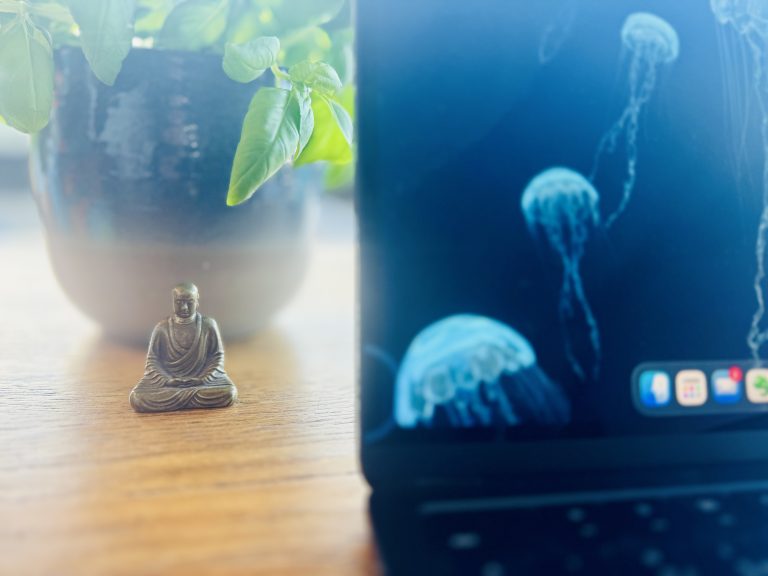
- Every morning as soon as I sit at my desk, with my little Buddha statue in front of me.
- Whenever I feel anxiety/fear/worry/panic during the day about something I can’t anticipate or control.
- Before getting out of bed, if I happen to wake up and feel immediately anxious (nowadays thankfully a rare occurrence).
The important thing however, is not to just repeat the words each day automatically and absentmindedly. To make this effective in managing anxiety and control issues, it must be said slowly and mindfully, with full attention and conviction.
A Secular Serenity Prayer for Anxiety
My Daily Serenity Mantra
I have the strength to accept the things I cannot control
The courage to change the things I can
And the wisdom to know the difference
Why Use The First Person?
You’ll notice I say this in the first person, unlike the original format. Using the first person transforms the serenity prayer from a request into a reinforcement, shifting you from seeking strength, to recognising that it’s already there. Saying in the first person has the following benefits:
- Builds self-efficacy: reinforces that the ability to cope already exists within you.
- Reduces learned helplessness: shifts you from passivity to agency, interrupting patterns identified by Martin Seligman
- Reframes your thinking (CBT principle): this turns “I can’t handle this” into “I can handle this,” reducing emotional reactivity
- Feels more real and actionable: present-tense language is processed as a current truth, not a future wish
- Strengthens internal control: trains the mind to rely on inner resources rather than external support
If you suffer from control anxiety, and have been looking for a simple daily practice in letting go, give this a try, and let me know how you find it. Please do get in touch if you find it helpful.
If you’d like to learn more from me then look into joining my next 4 Days Yoga and Buddhist Meditation Spa Retreat on stunning Lake Schwarzsee in Switzerland, or certifying as a confident and professional 200 hrs Yoga Alliance teacher on my next course in France!
Namaste xx