
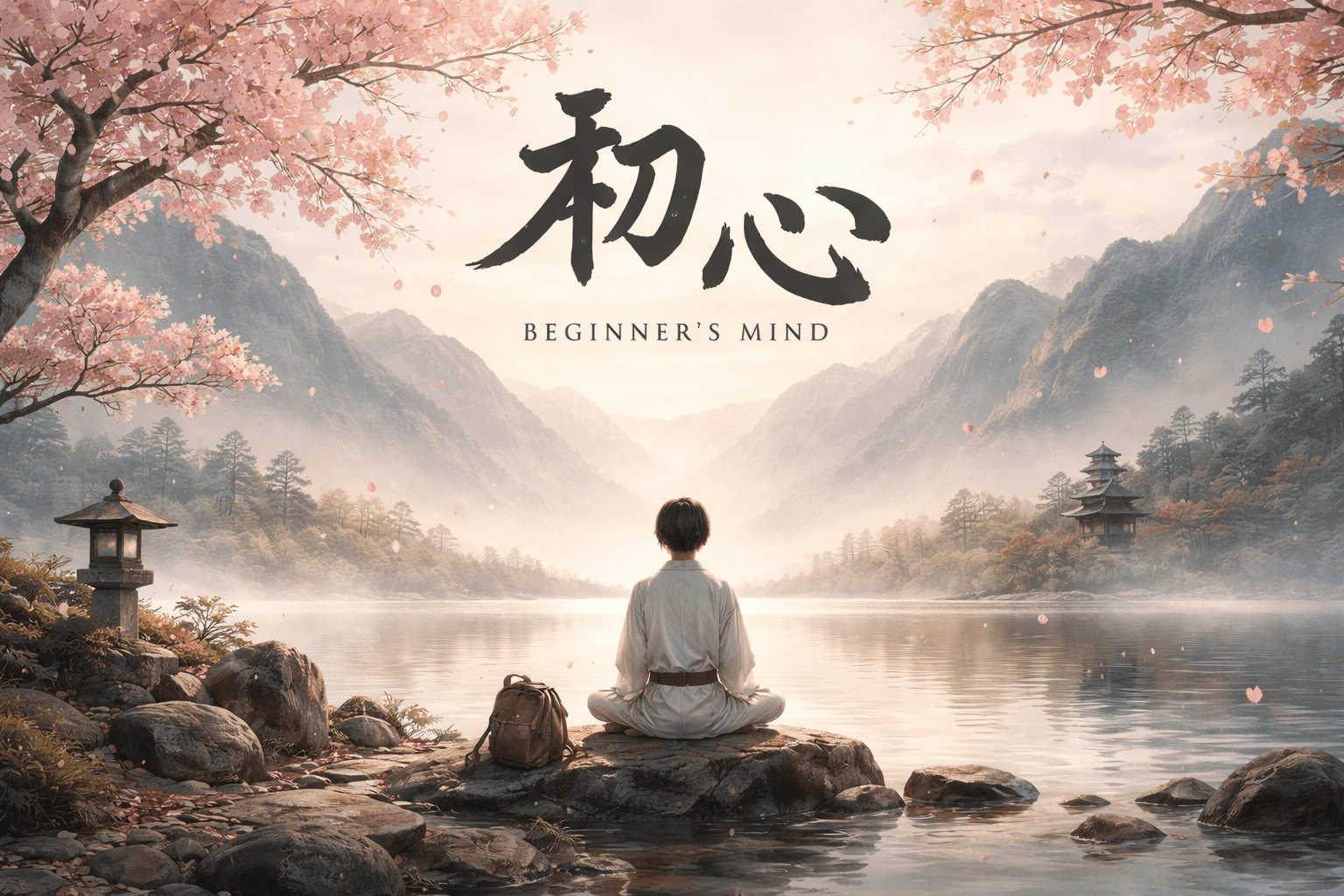
Shoshin – Zen Mind Beginner’s Mind
If you’ve ever stepped onto your mat to practice yoga or meditation, and thought, “I should be better at this by now,” you’re not alone. The longer we practice, the more we tend to carry invisible baggage into our yoga and meditation practice, with expectations, comparisons, and a idea about what’s ‘working’, what ‘should’ be working, and what isn’t.
‘Shoshin’, or beginner’s mind, offers a different perspective, and one that I always encourage by students and clients to adopt. It’s the willingness to meet each moment as if it’s new, by being curious, humble, and receptive to the unknown. And it’s not just an ancient Zen Buddhist concept for meditation cushions. A beginner’s mind can transform how we practice yoga, how we sit in meditation, and how we live your everyday lives.
What is Shoshin / Beginner’s Mind?
Shoshin is often translated as beginner’s mind, a mind that is open, eager, and free from the rigidity of expectations, or already knowing. It doesn’t mean being naïve or unskilled. It means staying open to experience, without filtering everything through habit or preconceptions.
You can think of it as the difference between:
-
Expert mind: “I know what this pose feels like.” “I know how this meditation goes.” “I know how this conversation will end.”
-
Beginner’s mind: “Let me feel this pose today.” “Let me meet this breath right now.” “Let me listen without rehearsing my response.”
The “expert” approach isn’t wrong, because experience is valuable. The problem is that certainty can close the door to learning. Whereas a beginner’s mind keeps the door open.
Three qualities of beginner’s mind
-
Curiosity: “What’s real and true right now?”
-
Humility: “I might not see the whole picture, and my preconceptions aren’t correct today.”
-
Presence/Mindfulness: “This moment is all I need to pay attention to.”
The Benefits of Beginner’s Mind
When you practice beginner’s mind, you shift from performing your practice, to participating in it. That change can be subtle, but it’s powerful.
Beginner’s mind tends to:
-
Reduce perfectionism and comparison
- Reduces ego by letting go of the need to be an expert or prove yourself
-
Make practice feel lighter and more sustainable
-
Improve body awareness and reduce “pushing through” or injuries
-
Deepen meditation by softening the urge to control
-
Create more ease in relationships (less assumption, more listening)
In other words, shoshin isn’t a philosophy you think about, but a way of paying attention.
Beginner’s Mind Meditation: Practicing as if You’ve Never Sat Before
It’s easy to bring “goal-thinking” into meditation: I want peace. I want clarity. I want fewer thoughts. But meditation is less about fixing or changing something, and more about meeting something.
The beginner’s mind approach to meditation
Try swapping these intentions:
-
From “I’m trying to stop thinking”
to “I’m noticing thinking.” -
From “I need a good meditation”
to “I’m willing to be with this meditation.” -
From “I’m behind / distracted / bad at this”
to “This is what a mind does. Let’s begin again.”
I think of the words ‘notice’ and ‘fresh start’ as the essence of beginner’s mind in practice.
A simple shoshin meditation (10 minutes)
-
Sit comfortably (upright but not rigid), and begin the meditation with the mindset that you’ve never meditated before, without any ideas of what it should be like, or what should happen or not happen.
-
Feel your breaths as if you’ve never breathed before.
-
Where do you feel breath most clearly today? The nostrils, chest, belly?
- Follow the journey of the inhale part, then after a while the exhale, and then the pauses in between each.
-
-
Breathe mindfully with humility and curiosity
-
When you notice you’ve drifted, kindly and softly bring your awareness back to each new breath.
-
Begin again each time, not as a correction, but as a fresh start.
If your mind wanders 100 times, you practice beginner’s mind 100 times. And don’t think of it as failure, think of it as shoshin training. As you practice your mind will likely begin to wander less often. Then you may still have days when it wanders off 150 times, as happens with Buddhist monks. Without judgement or frustration, which will hold you back, just keep returning calmly and kindly, to a fresh start.
After each meditation
Ask yourself, “What did I learn about my mind today?” Instead of asking yourself something like “was it good?”, “How could it have been better?”, “What went wrong?”
Beginner’s mind is interested, not judgmental.
Beginner’s Mind Yoga: Turning Familiar Poses into Fresh Practice
Many people assume beginner’s mind in yoga is just for beginners. But advanced practitioners may benefit from it even more, because we can become complacent in our practice, and we can get into bad habits without realising it.
For yoga teachers: I remember worrying when I first started teaching, if I had beginners in a class with more advanced students. My main concern was that the more experienced practitioners were going to get bored going through the basic principles of the poses and breathing exercises. Then I realised that this was the prefect time to introduce the practice and benefits of shoshin, encouraging everyone to adopt a beginner’s mind, especially to increase their patience, compassion, and humility, if they started to feel annoyed. We were all beginners once!
A beginner doesn’t yet have a script, but a long-time practitioner does, and that script can dull the senses.
How to practice shoshin yoga (especially if you’re experienced)
1) Start with sensation, not shape
Instead of chasing the “ideal” form, try:
-
How does each area of my body feel today compared to last time?
- Do I feel different sensations on one side of my body compared to the other in these poses?
-
Where is there tension?
- Is my breath flowing easily?
-
What’s the best version of this pose or movement for my body today?
- Have I let an alignment cue slip that I should correct?
Shoshin is not about how a pose looks, but being true to how it should feel for you today, while being safe.
2) Use “first time” cues
Pick one pose you do often (Down Dog, Warrior II, Child’s Pose) and approach it like an experiment:
-
How do my heels feel about reaching the mat today?
-
What happens if I soften my jaw?
-
What’s the difference between effort and strain?
- Is my mind on the sensations in my body or on my expectations of it?
3) Let your breath be the teacher
Beginner’s mind respects feedback, and your breath is a good measure of what’s happening in the present moment:
-
If the breath is smooth, you’re probably within a sustainable range.
-
If the breath is jagged, fast, or holding, it may be a sign to reduce intensity.
This isn’t about always going easy, it’s about staying connected and in line with what’s right in this moment.
4) Reframe “modifications”
A beginner’s mind doesn’t see props and modifications as “less than.” It sees them as intelligent tools for integration, humility, and self-compassion.
Blocks, straps, knees bent, smaller range of motion etc aren’t compromises. They’re ways of staying honest, safe, and present.
5) Practice “one mindful rep”
If you love flow, try making one Sun Salutation unbelievably slow, attentive, and mindful:
-
Move with very slow, long breaths.
-
Feel every transition, and every part of the body, in every pose.
-
Track weight shifting and differences in each side of the body.
- Find your balance before pushing too much in a pose.
-
Notice the moment your mind starts performing.
One mindful rep can change the rest of your whole practice.
How To Cultivate Beginner’s Mind: Shoshin in Everyday Life
We suffer a lot from an “I’ve done this before/been here before, and I already know” mindset:
-
“I know what this email is going to say.”
-
“I know how my partner will react.”
-
“I know I’m going to mess this up.”
Beginner’s mind interrupts that loop, and creates space between the known, and knowing.
Three micro-practices for daily life
1) The “Three Noticings” reset (30 seconds)
Anytime you feel rushed or reactive, pause and notice:
-
One body sensation (feet on the floor, breath in chest)
-
One sound (near or far)
-
One visual detail zoom in to see something you hadn’t noticed before
This is shoshin as a nervous-system reset, taking you to the direct experience.
2) “Assume you don’t know”
Before a conversation you anticipate being difficult, try asking:
- “What if I put myself in that person’s place to see and feel it from their viewpoint?”
-
“Is there any knowledge or experience I could be missing?”
-
“Can I listen before already formulating a conclusion?”
Beginner’s mind doesn’t mean you abandon discernment. It means you don’t let certainty replace awareness.
3) Beginner’s mind in routine moments
Choose one daily activity (making tea, showering, walking) and do it once a day as if you’ve never done it before:
-
much slower
-
taking note of all your senses
-
mindfully without multitasking, taking in every detail.
This brings us the same benefit as meditation: attention without attachment.
Advice for Common Misunderstandings
“Beginner’s mind means I have to forget what I know.”
No, it means your knowledge doesn’t become a cage, and you can be skilled and curious.
“If I’m not improving, what’s the point?”
Beginner’s mind doesn’t remove progress. It stops progress from becoming your only measure of value. Paradoxically, that often leads to better progress because expectations and performance soften.
“I tried beginner’s mind and my mind was still busy.”
That’s normal. Beginner’s mind meditation isn’t a promise of quiet, but a relationship with whatever appears in that moment.
Teaching Shoshin: How to Guide Beginner’s Mind in Class
If you teach yoga or meditation, shoshin is one of the most liberating themes you can offer, because it releases students from the pressure to “get it right” or strive for what they’ve attained before.
Try weaving in:
-
Permission language: “See what’s right for your body today.” “Practice self-compassion.”
-
Inquiry cues: “How does each part of the body feel?” “How are you breathing?”
-
Non-comparison reminders: “Your practice is not in competition with anyone else’s body, or with what your body could do yesterday.”
You can even invite students to pick one familiar pose and explore it with beginner’s mind: slower, mindfully, and more sensory.
FAQs
What does shoshin mean?
Shoshin is commonly translated as beginner’s mind, an attitude of humility, curiosity, self-compassion, and willingness to learn, even when you’re experienced.
How do you cultivate beginner’s mind in meditation?
Use a gentle “begin again” approach: choose an anchor (breath/body/sound), notice distractions without judgment, and return softly as a fresh start. Focus on noticing, not achieving.
How do you practice beginner’s mind in yoga?
Prioritize sensation over shape, use the breath as feedback, explore familiar poses with curiosity, feel what’s different about your body doing this pose compared to last time, and treat modifications/props as intelligent choices rather than “going backwards.”
Is beginner’s mind the same as being a beginner?
No. Beginner’s mind is an attitude, not a skill level. You can be highly skilled and still practice with shoshin.
The Gift of Beginning Again
The most practical definition of shoshin/beginner’s mind is: the willingness to begin again, right here.
Begin again with each breath.
Begin again with one pose.
Begin again with one moment of listening.
In meditation, yoga, and life, beginner’s mind doesn’t demand that you go backwards. It simply means meeting the moment with fresh eyes, as if for the first time.
Practice shoshin with Charlie on her next 4 Days Yoga and Buddhist Meditation Spa Retreat on peaceful Lake Schwarzsee in October 2026, or by training as a 200 hrs Yoga Alliance teacher on her 2 weeks hybrid course in France.